You are not logged in. Please register or login.
- Topics: Active | Unanswered
#161 Re: The Garden » The United Kingdom General Election, 2nd May 2024 » 498 weeks ago
You're definitely paranoid, mate. 
#162 Re: The Garden » The United Kingdom General Election, 2nd May 2024 » 498 weeks ago
Understanding the anti-immigrant mindset
Updated June 23, 2016 2:12 PM
As Britain decides whether to leave the European Union, it is clear that one issue created the greatest source of tension: immigration.
British attitudes toward immigration have been changing for some time, and especially since the European Union expanded to include many of the former communist countries of Eastern Europe. According to the British Social Attitudes Survey, in 1995, 63 percent of the British public were in favor of reducing immigration. By 2008, this had risen to 78 percent, where it has stabilized.
For a country built on a long history of inward migration — from the Flemish textile workers of the 14th century through the Commonwealth workers of the 20th — this change has been surprising and has been attributed to economic unease. But this may not be the case.
In a recent paper, researchers from the London School of Economics addressed the issue that often appears at the heart of public concerns: jobs and wages. Over a period in which the number of people from the EU living in Britain tripled - to 0.9 million in 1995 to 3.3 million in 2015 — there was no adverse impact on British workers in terms of a substitution of foreign-born labor for native British labor. While there had certainly been labor market pain, it wasn’t a result of immigration but of the slow recovery from the global financial crisis.
EU immigrants are, on average, better educated than the native-born population. They are more likely to have a job and to pay more in tax than they receive in benefits and public services. A study of 22 Organization for Economic and Cooperation and Development countries published last year found that immigration boosts productivity growth. Applying the findings to Britain suggests that halving Britain’s immigration would knock 0.32 percent off productivity growth each year. The LSE authors wrote:
“We can confidently say that the empirical evidence shows that EU immigration has not had significantly negative effects on average employment, wages or inequality for British people.”
advertisement | advertise on newsday
Looking beyond Britain and the narrower question of EU migration, economic evidence published by the American Economics Association suggests that lowering barriers to freedom of movement could add more to the global economy than any other form of market liberalization, including the free movement of goods and capital.
In research published this week, pollsters Ipsos MORI found that 46 percent of Britons think that the economy has benefited from EU immigration compared with only 30 percent who think the opposite. Less than one in four believe that EU immigration has had a negative effect on local areas. The positive economic arguments, it seems, haven’t fallen on deaf ears.
But asked whether immigration from the EU has been “good for Britain on the whole,” the survey reveals a much deeper division: four in 10 believe that immigration has been positive, with an equal number believing that it has been bad (20 percent either don’t know or think it’s neutral). According to the British Social Attitudes Survey, “more than half of people (54 percent) who see immigration as good for the economy also want to see immigration reduced.”
Whatever happens with Thursday’s vote, a debate over immigration is likely to be at the heart of U.K. politics for some time to come. Opinions are complicated, and not necessarily dictated by logic. But even Britons fearful for their futures don’t necessarily think immigration has come with an economic cost. In a year of turmoil and unease, this is at least something to build on.
#163 Re: The Garden » The United Kingdom General Election, 2nd May 2024 » 498 weeks ago
It was scary last night... Floods of rain and thunder. 
It won't be a massive victory for pro EU voters.
Referendum LIVE: Remain ahead by 4% in final poll - but it’s close
#164 Re: The Garden » The United Kingdom General Election, 2nd May 2024 » 498 weeks ago
Less than 2 hours to go.
Voters stranded by rail problems
The problems at London transport hubs could potentially affect the ability of thousands of people to vote.
Waterloo, where there appears to be no service at all, serves 90 million passengers a year, which is about 250,000 a day on average (although the average obviously includes weekends and holidays).
Cannon Street, Charing Cross, London Bridge, Victoria, and probably other stations have also been affected. They are all major commuter stations with many people likely to have left for work this morning before polls opened.
The Rail Delivery Group says among the train operators affected are Abellio Greater Anglia, Gatwick Express, Southern, South West Trains and Thameslink.
Among those stranded is the broadcaster and journalist Sian Williams.
#165 Re: The Sunset Strip » What Are You Listening To? » 498 weeks ago
Isaac Hayes - Shaft
#166 The Garden » Hundreds of Genes Spring Back to Life in the Days After Death » 498 weeks ago
- Yamcha
- Replies: 3
Hundreds of Genes Spring Back to Life in the Days After Death
We assume that all biological processes come to an end when we die, but new research shows that many genes remain active for up to four days following clinical death. These zombie genes can’t bring a person back to life, but this discovery has serious implications for forensics and organ donor recipients.
A pair of new studies, both of which are still undergoing peer review, are teasing our conceptions of death and what goes on in our bodies after we die. University of Washington biologist Peter Noble and his pals have shown that certain parts of the body remain active even after the rest of it has come to a grinding halt. In future, these insights could be used by scientists who are seeking to improve the way that donated organs are preserved, and by forensic investigators seeking to determine when a person was killed.
As Mitch Leslie points out in Science Magazine, previous work on human cadavers demonstrated that some genes remain active after death, but we had no idea as to the extent of this strange phenomenon. By analyzing the tissue of recently deceased animals, Noble and his colleagues managed to pinpoint hundreds of genes that were still functioning in the days—yes days—following death. If the same thing applies to us—and there’s no reason to believe it doesn’t—it could change the way we perceive the recently deceased and how we define death.
In the first of the two studies, the researchers sought to determine which genes out of about a thousand might still be functioning in zebrafish and mice in the immediate days following death. To their surprise, the researchers found that hundreds of genes sprung back to life. Not only that, the activity of some of these genes actually increased. Most of these genes eventually gave up after about 24 hours, but some remained active for as much as four days after death. That’s surprising, to say the least.
The majority of these zombie genes were not random in terms of function. Each of them play an important role when an animal experiences some kind of trauma or illness. For example, some genes that were ramped up are responsible for stimulating inflammation and the immune system as well as for countering stress. Some genetic activity, like a gene that’s responsible for embryonic development, baffled the scientists. Noble suspects that this gene becomes active because the cellular environment in dead bodies must somehow resemble those found in embryos.
Importantly, several genes that promote cancer also became active. This may explain why many organ donor recipients develop cancer. This tidbit of information could help scientists develop better methods of organ preservation prior to transplantation.
The second study, also co-authored by Nobel, shows that similar assessments of postmortem genetic activity could be used in criminal and civil investigations. Forensic teams could take genetic samples at murder scene, for example, to get a better estimate of time of death.
As noted, these two papers have yet to appear in a peer-reviewed journal, and the genetic evaluations were not performed on human cadavers. Further research will be required before we draw too many conclusions about these fascinating studies.
#167 Re: The Garden » The United Kingdom General Election, 2nd May 2024 » 498 weeks ago
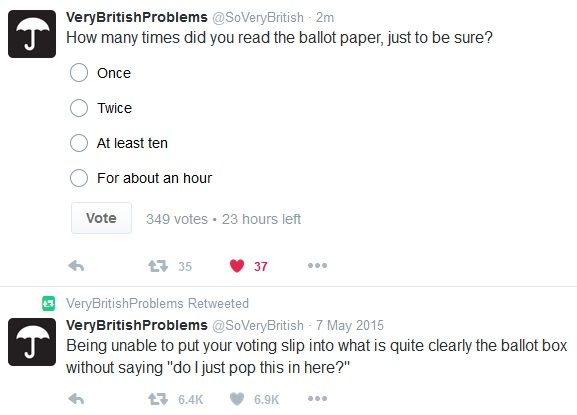
I always read ballot papers like, 5 times . 
#168 Re: The Garden » The Randomness Thread » 498 weeks ago
Hopefully it won't rain tomorrow.
#170 Re: The Garden » The United Kingdom General Election, 2nd May 2024 » 498 weeks ago
Blimey... Ignorance and hatred getting manipulated.
Now trending on Twitter: #dogsatpollingstations How cute.
